Key Takeaways
- Start with data. A simple waste audit plus a bill review reveals how much organic material you generate, what it’s costing you, and where to focus first.
- Prevention and donation come before recycling. Stop throwing away food you could avoid buying or safely donate, then recycle the inedible scraps.
- Contamination is the top risk to program success. Clear rules, bold signage, spot checks, and fast feedback keep loads clean and processors happy.
- Train early, train often. Hands-on instruction and multilingual visuals at the point of discard build habits that stick, even with staff turnover.
- Partner with a local expert. A DFW-based provider like Fusion Waste & Recycling will tailor pickup schedules, right-size containers, and help you hit your landfill-diversion goals.
A commercial organics recycling program helps kitchens, cafeterias, and grocery stores cut landfill waste, lower disposal emissions, and build a credible sustainability record. Many organizations across the Dallas-Fort Worth (DFW) Metroplex and North Texas now manage organics alongside traditional trash and recycling. Evolving environmental expectations, new organics policies in several U.S. markets, and the operational value of controlling food waste are driving this shift. In this guide, Fusion Waste & Recycling, the independent, Minority Business Enterprise (MBE) environmental-services partner trusted by DFW businesses, walks you through a practical, step-by-step approach to designing a program that works in the real world. You’ll learn how to audit your waste, set goals, prevent avoidable food waste first, separate acceptable organics efficiently, prevent contamination, and track results so you can scale with confidence.
What Is a Commercial Organics Recycling Program?
Commercial organics recycling is more than placing a green bin in the kitchen. It depends on a clear understanding of the materials, processing options, and daily routines that make collection work.
Definition
In a commercial organics recycling program, businesses systematically collect and process organic materials, primarily food scraps and other biodegradable matter, that would otherwise be landfilled or incinerated. Unlike traditional recycling, which relies on mechanical processing to turn items like paper, cardboard, metal, and glass into new materials, organics recycling uses biological processes. Under controlled aerobic conditions, microorganisms transform organic matter into compost. This biologically stable soil amendment returns nutrients to the earth and improves soil structure. Some facilities use anaerobic digestion, which breaks down organics without oxygen to generate biogas (a renewable energy source) and a nutrient-rich digestate that may be further processed into soil products. Depending on local processing capacity and facility rules, acceptable materials can include food scraps, some food-soiled paper, landscaping trimmings, and occasionally untreated wood. The exact mix is processor-specific, so always confirm what your receiving facility accepts and how it wants materials prepared.
Businesses That Benefit Most
While nearly any organization that produces organic material can benefit, several sectors generate significant, consistent volumes and are prime candidates for landfill diversion. Restaurants, grocery stores, and hotels typically handle large quantities of perishable inventory and prep waste. Corporate cafeterias manage similar volumes. Schools and universities run extensive dining operations with recurring pre- and post-consumer scraps. Hospitals and senior living centers serve meals around the clock under strict sanitation requirements. Event venues and stadiums see high-peak volumes with limited back-of-house space. Food manufacturers, processors, and distribution centers manage both raw inputs and byproducts that can add weight and cost to traditional trash. Organics collection complements these operational priorities. It cuts trash volume, supports sustainability targets, and helps teams manage sanitation through clear, consistent workflows.
Why Businesses Should Implement an Organics Recycling Program
An organics program can reshape the way your operation handles food waste, service costs, and sustainability commitments. The benefits below explain why it’s worth the extra effort:
Environmental Benefits
Food waste decomposes without oxygen in a landfill, producing methane. Diverting organics from landfills is one of the most effective ways to reduce this potent greenhouse gas. When you recycle organics through composting or anaerobic digestion, you’re not just avoiding emissions; you’re creating valuable end products. Compost improves soil health and boosts water retention to support resilient landscapes. Anaerobic digestion offers a different benefit by generating renewable energy. For DFW organizations, this supports healthier local environments and a more sustainable North Texas.
Financial Benefits
Because food waste is heavy, hauling it as trash costs money. A well-managed commercial organics recycling program can reduce your overall waste bill by right-sizing trash service, adjusting pickup frequency, and avoiding overage fees. Preventing avoidable food waste during purchasing, prep, and service often yields the largest savings before recycling even begins. Managers who track food waste by department or shift can pinpoint where to fine-tune ordering and production, which lowers the cost of goods sold. Actual savings depend on your material mix, contamination rates, labor practices, collection frequency, and local disposal markets, so plan to measure results and adjust as you go.
Regulatory Compliance
More cities and states now require large commercial generators to recycle organics or reduce edible food waste. The details vary by location, generator size, materials covered, and facility capacity. Even if your DFW site isn’t currently subject to a mandate, building a strong program now keeps you ahead of potential compliance changes and sets up your operation to scale without disruption. Always verify local requirements with your service provider and the appropriate agencies, and get a written list of acceptable materials from your processing facility.
Brand Reputation
People notice how businesses manage their environmental footprint, from customers and employees to investors and community partners. Demonstrating a credible organics recycling program, paired with prevention and donation, positions your brand as a sustainability leader. This commitment strengthens employee engagement and aligns with corporate environmental, social, and governance (ESG) goals. It also creates a clear point of differentiation in competitive markets such as hospitality, retail, healthcare, education, and food manufacturing.
Implementing a Commercial Organics Recycling Program: Step-by-Step Procedure
Successful programs start small and scale only after the process stabilizes. These ten steps help build a clean, efficient system for daily operation.
- Step 1: Conduct a waste audit. Review recent waste and recycling invoices, then perform a quick physical audit. Identify where organics are generated (prep lines, dish return, deli, bakery, produce trimming, patient floors, concessions), estimate daily volumes by area, and note contaminants you frequently see. This baseline shows your diversion potential and where to focus first.
- Step 2: Set clear recycling goals. Define what success looks like. Examples include “divert 60% of back-of-house organics in six months,” “cut trash pickups from five to three per week by quarter’s end,” or “reduce pre-consumer food waste by 20%.” If you operate multiple sites, set a pilot location goal first, then a timeline to roll out to additional facilities.
- Step 3: Identify acceptable organic materials. Processors, not generators, decide what’s in-bounds. Get a written list of acceptable and prohibited items from your receiving facility. Clarify rules on meat, dairy, bones, shells, food-soiled paper, compostable serviceware, produce stickers, tea bags, and coffee filters. Ask about bagging policies and whether certified compostable liners are allowed. Document these rules in your training materials.
- Step 4: Choose the right recycling partner. Select a knowledgeable, local environmental-services partner offering personalized, step-by-step design rather than a rigid, one-size-fits-all program. As a DFW-based, MBE-certified provider with 35+ years of combined experience, Fusion Waste & Recycling helps you create a plan that fits your operation, from container selection and right-sized service to staff training and clear signage. We’re New Age Thinkers focused on maximizing landfill diversion with practical, on-the-ground support.
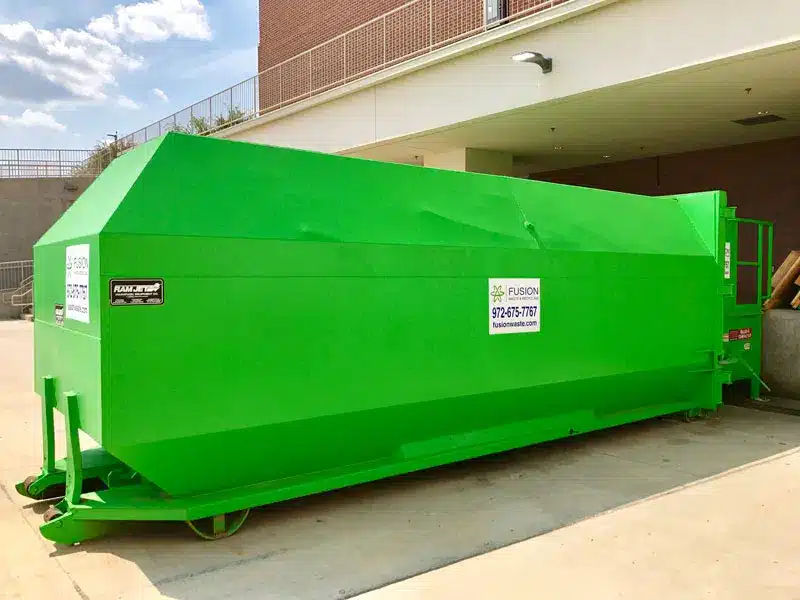
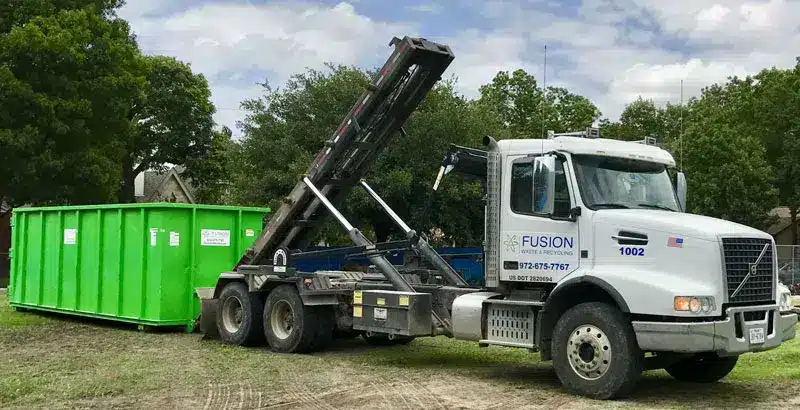
- Step 5: Select collection containers. Match container types to each workspace. Use leak-proof, lidded bins or toters with bold “Organics Only” labels in kitchens and prep areas. Choose durable containers near dish areas to handle plate scrapings and permitted liquids. Slim-profile bins or smaller toters at each station reduce walking and spillage in compact spaces. For outdoor consolidation, your partner can provide dedicated organics containers sized to your volume and pickup plan. When specifying exterior containers, choose from approved front-load dumpster sizes — 2, 3, 4, 6, or 8-yard — or roll-off (open-top) dumpsters — 20, 30, or 40-yard — based on generation, storage space, and truck access.
- Step 6: Develop sorting procedures. Keep source separation simple. Place organics bins exactly where scraps are generated, keeping trash and recycling nearby but clearly differentiated. Standardize a consistent color and label for organics across your site, and post multilingual, photo-based signage that shows “Yes” and “No” items based on your processor’s rules. Define who is responsible for moving full containers, when they get swapped, and how often bins are cleaned.
- Step 7: Train employees. Hands-on training is necessary to show staff what goes in, what stays out, and why contamination matters. Demonstrate the bin setup, liner policy, and transfer routine. Use short refreshers during shift huddles, add eye-level signage where items are discarded, and provide training in the languages your team speaks. Include facilities, custodial, and night-shift crews so no step gets missed.
- Step 8: Launch the program. Start with a back-of-house pilot, where you can control inputs and coach users directly. Avoid customer-facing collection until your team hits quality targets and contamination trends downward. Document the pilot scope, schedule, and responsibilities. Encourage feedback from line cooks, dish teams, custodial staff, and managers to catch friction points early.
- Step 9: Monitor performance. Track diversion weights, pickup frequency, contamination observations, rejected loads, and any fees. Pair this with operational data: training completion, spot-check results, and photos of common problem items. Ask your team for feedback on the process, then adjust container placement, signage, or collection cadence accordingly.
- Step 10: Improve and expand the program. Use your data to refine sorting rules, target hot spots for additional training, and adjust service to match actual generation. Once the process is stable and contamination is under control, expand to more departments or locations. Add prevention and donation initiatives to capture bigger savings and deeper environmental impact.
Common Challenges and How to Overcome Them
Most setbacks happen in daily routines, not the original plan. Looking ahead to common challenges gives your team time to set clear responsibilities and respond before small issues affect collection quality.
Employee Participation
High turnover, competing priorities, and tight shifts frequently stall adoption. Name a program champion at each site; choose someone respected on the floor who can answer questions and reinforce good habits. Make separation the easy choice by placing bins within arm’s reach and using unmistakable labels. Keep recognition public and simple: give shout-outs during team meetings, share before-and-after photos, and celebrate contamination-free weeks with small rewards. Short, frequent refreshers beat long, one-time trainings.
Contamination
Contamination, or materials your processor can’t accept, such as gloves, plastic wrap, hairnets, or produce stickers, is the biggest threat to any commercial organics recycling program. It drives up costs, risks rejected loads, and can undermine trust with your processor. Control contamination using clear, photo-rich signage at the point of discard alongside standardized colors for organics. Routine spot checks and quick, respectful feedback also help. Investigate root causes when issues repeat: Are people unclear on the rules? Is the right bin too far away? Are materials mislabeled or inconsistent? Tackle the cause, not just the symptom.
Odor and Pest Issues
Manage perishable organics exactly like food inventory. Use lidded, leak-proof containers, line them if your processor allows, and empty them on a set cadence matched to volume and temperature. Rinse and sanitize bins regularly to prevent buildup. Outdoors, keep lids closed, clean spills promptly, and schedule more frequent pickups during heat waves or events. Your hauler can help tune service frequency to balance sanitation and cost.
Limited Space
DFW facilities frequently deal with tight kitchens and constrained loading docks. When space is scarce, choose smaller interior bins placed directly at prep and dish stations to minimize travel distance. Consolidate into a shared exterior container with more frequent pickups, or coordinate shared service with neighboring tenants if your property manager approves. Right-sizing is the goal — just enough capacity to avoid overflow, kept clean and close to the workflow.
Best Practices for Long-Term Success
Launching the program is an important milestone, but keeping it consistent is the real work. Regular communication, short checks, and practical adjustments help the program stay useful as staffing and operations change.
Maintain Consistent Communication
Maintain regular communication with your internal team and your recycling partner. A 15-minute monthly check-in can surface subtle issues before they turn into rejected loads or rising costs. Share contamination photos, discuss service exceptions, and agree on quick adjustments to container placement or signage. Transparency builds trust and sustained performance.
Perform Routine Waste Audits
Plan quick mini-audits, especially after menu changes, seasonal peaks, or staff transitions. Pull a sample of organics and trash to see what’s creeping into the wrong bin. Audits don’t need to be exhaustive; a concise recurring check by your champion can reveal new training needs or prevention opportunities.
Celebrate Successes
Employees respond well when they see their impact. Post monthly diversion stats and milestones, such as “4,500 pounds of organics diverted in May” or “Contamination dropped to 1.5% this quarter.” Translate results into relatable wins: “That’s the equivalent of X bags of trash not landfilled” or “enough compost to enrich Y garden beds.” Recognition keeps momentum high and helps new team members buy in.
Stay Updated on Local Regulations
Policies shift. Assign someone to monitor local and state updates, connect with industry groups, and check in with your service provider. If you operate in multiple jurisdictions, maintain a simple compliance matrix so each site knows its rules. Proactive attention eliminates last-minute scrambles and ensures your program is always audit-ready.
How Technology Can Improve Organics Recycling
Data can make day-to-day waste decisions much easier. The tools below can help organizations see what’s happening at the point of collection and make smarter service decisions.
Digital Waste Tracking
Smart scales and tracking software help quantify food waste by station, shift, or menu item. That data reveals patterns (like overproduction at a specific meal period) that you can fix through ordering and prep changes. Over time, tracking connects prevention efforts and organics diversion to measurable results.
Smart Collection Solutions
Some organizations use container sensors to estimate fill levels and help their hauler align pickups with actual need, reducing unnecessary service. For multi-site organizations, dashboards centralize weights, contamination notes, and service histories so managers can compare locations, identify leaders, and target coaching where it matters most.
Employee Engagement Tools
Digital training modules, quick-tip videos, and internal messaging apps keep separation rules top of mind. Short, visual refreshers delivered in the languages your team uses build confidence and consistency. QR codes on signs that link to a 30-second “What Goes Where” video can cut confusion during busy shifts.
Measuring the ROI of an Organics Recycling Program
Good reporting turns a recycling effort into a business case. Use the measures below to see how the program affects costs, landfill diversion, and daily operations.
Financial Metrics
Track costs and savings across your operation to build a balanced view.
- Total organics service cost
- Trash service cost after organics (frequency, container size, overage fees)
- Contamination fees and rejected loads
- Avoided disposal cost (reduced trash tonnage x landfill/transfer rate)
- Food purchasing savings from prevention initiatives
A simple ROI framework looks like this: ROI = (Avoided trash costs + Prevention-related purchasing savings + Any donation tax benefits, if applicable + Operational efficiencies) – (Organics service cost + Containers and liners + Training and labor time + Contamination fees). Because every site is different, review ROI quarterly and adjust service and training to improve outcomes.
Sustainability Metrics
Support your environmental story with specific data points.
- Pounds or tons of organics diverted
- Overall landfill-diversion rate for the facility
- Contamination rate (percentage of unacceptable materials in organics)
- Pickup frequency and missed service events
- Edible-food donations (pounds and meals, where applicable)
Share key results internally and externally to demonstrate progress toward your ESG or Zero Waste commitments.
Business Metrics
Monitor these metrics to connect the program to broader business goals.
- Employee training completion and participation by department or site
- Bin-audit scores and trend lines
- Customer, student, or patient feedback related to sustainability
- Coverage in sustainability reporting and community relations
- Readiness for emerging regulations and relevant sustainability certifications
These measures translate day-to-day sorting into meaningful operational and reputational value.
Why Choose Fusion Waste & Recycling for Your DFW Organics Program
Commercial organics recycling works best with a partner that understands your material stream, your facility, and your goals. Fusion Waste & Recycling provides local, step-by-step support that turns an ambitious plan into a workable daily routine.
Local, Personalized, and Built for Results
Fusion Waste & Recycling is an independent, MBE-certified environmental-services partner serving the Dallas-Fort Worth Metroplex and North Texas. With over 35 years of combined experience and more than 10 million pounds of waste and recycling managed, we design personalized, step-by-step organics programs that meet your goals and your workflow. As New Age Thinkers, we focus on maximizing landfill diversion without adding friction to your operation through right-sized containers, flexible pickup schedules, hands-on training, and practical signage. And because we offer wide-ranging recycling — from cardboard, plastics, and glass to organics, confidential business document shredding, electronic waste disposal, Styrofoam, batteries, and light bulbs — you get a single, accountable partner for your sustainability journey. Whether you need a 2-, 3-, 4-, 6-, or 8-yard front-load solution or a 20-, 30-, or 40-yard roll-off for higher volumes, we’ll help you choose the right equipment, dial in service, and train your team.
Getting Started
Ready to take the first step? Start with a clear view of your current waste stream, then build the program around the people, spaces, and materials in your operation.
Your Next Three Moves
Follow this path to establish a commercial organics recycling program for your DFW operation.
- Schedule a quick waste and bill review to estimate your organics potential and identify savings opportunities, including prevention.
- Confirm acceptable materials and end-market requirements with your processing facility. We’ll help you get it in writing.
- Launch a back-of-house pilot with right-sized containers, hands-on training, and clear signage. Track results, refine, and scale.
When you’re ready, Fusion Waste & Recycling will walk you step by step through designing, implementing, and optimizing a program that diverts more, costs less, and keeps your team confident and engaged.
Conclusion
A successful commercial organics recycling program requires a clear baseline, realistic goals, and a plan built around actual workflows. Prevent avoidable food waste first. Confirm exactly what your processor accepts. Place the right containers where organics are generated, train your team with crystal-clear guidance, and launch with a back-of-house pilot. Then measure, refine, and scale. The environmental upside of reduced methane and healthier soils pairs with business benefits such as right-sized trash service and improved operational visibility. As New Age Thinkers in environmental services, Fusion Waste & Recycling partners with DFW businesses, school districts, and multi-family communities to design personalized, step-by-step programs that maximize landfill diversion. If you’re ready to build a cleaner, more compliant, and cost-effective waste and recycling strategy, start with a waste audit and let’s design an organics solution that fits your operation.
Frequently Asked Questions (FAQs)
Operations that handle food at any scale or manage landscaping are strong candidates. Heavy, wet trash loads, frequent overages, strict sustainability targets, or an interest in reducing greenhouse gas emissions all indicate it’s time to start. A quick waste audit plus a bill review will show your diversion potential and expected impact. Many restaurants, grocers, campuses, hospitals, hotels, corporate cafeterias, and manufacturers in DFW can benefit from organics diversion paired with prevention and donation.
It depends on the processing facility. Commonly accepted items include fruit and vegetable scraps, coffee grounds and filters, tea bags (without plastic), eggshells, and some food-soiled paper. Many facilities also accept meat, dairy, bones, and baked goods, although some won’t. “Compostable” serviceware may or may not be accepted. Always obtain a written list of accepted and prohibited materials from your processor and build your signage and training around it.
Costs depend on volume, pickup frequency, container needs, labor, and local disposal rates. Some businesses lower total waste expenses by reducing trash service as organics diversion increases. Others experience a modest net cost offset by prevention savings and sustainability goals. The best approach is to pilot at one site, track organics weights and contamination, right-size your service, then calculate ROI using real data from your operation.
Yes. Small restaurants, cafés, and boutique grocers can succeed with right-sized containers, convenient placement, and frequent, lightweight pickups. Start with back-of-house areas, keep rules simple, and train your core team well. A local partner like Fusion Waste & Recycling can tailor service and signage to keep the process easy and effective.
Controlling contamination requires visual, convenient, and consistent processes. Place organics bins at the exact point of discard, label them clearly with photos and “Yes/No” lists based on processor rules, and color-code across your site. Conduct spot checks, share quick feedback, and retrain when needed. If a particular item causes confusion (like a specific wrapper or coffee pod), add it to your signage and coach the team on what to do.
After collection, organic material is taken to a processing facility. Composting operations manage aerobic decomposition to create a stable, nutrient-rich soil amendment. Some facilities use anaerobic digestion to generate biogas (renewable energy) and digestate that may be further processed for soil use. End markets vary by facility and region; your processor can explain their pathway.
Several U.S. jurisdictions have adopted commercial organics requirements, but the details differ by location, generator size, materials, and available processing capacity. Requirements can also change over time. In DFW, confirm current obligations with your service provider and the appropriate agencies. Designing a flexible program now helps you stay ahead of compliance changes.
Site readiness, processor availability, service setup, and staff training dictate the implementation timeline. A focused back-of-house pilot can move quickly once a waste audit, container plan, and collection schedule are in place; allow additional time to stabilize contamination and validate service needs. Multi-site rollouts take longer, but a documented first-site playbook makes subsequent launches more efficient.
References
- U.S. Environmental Protection Agency. Composting. https://www.epa.gov/sustainable-management-food/composting
- U.S. Environmental Protection Agency. Wasted Food Scale. https://www.epa.gov/sustainable-management-food/wasted-food-scale
- U.S. Department of Agriculture, U.S. Environmental Protection Agency, and U.S. Food and Drug Administration. National Strategy for Reducing Food Loss and Waste and Recycling Organics. https://www.usda.gov/sites/default/files/documents/NATIONAL-STRATEGY-FOR-REDUCING-FOOD-LOSS-AND-WASTE-AND-RECYCLING-ORGANICS.pdf
- RecyclingWorks Massachusetts. Food Waste. https://recyclingworksma.com/how-to/materials-guidance/food-waste-2/
- CalRecycle. Mandatory Commercial Organics Recycling. https://calrecycle.ca.gov/recycle/commercial/organics/
- Zero Waste DC. Commercial Food Waste Diversion. https://zerowaste.dc.gov/commercialfoodwaste
- RecyclingWorks Massachusetts. Food Waste Diversion Guide for Restaurants. https://recyclingworksma.com/wp-content/uploads/2014/02/RW-Restaurant-Food-Waste-Diversion-Guide-2.3.14.pdf
- New South Wales Environment Protection Authority. Business Food Waste. https://www.epa.nsw.gov.au/Your-environment/Recycling-and-reuse/business-food-waste
- Rochester Institute of Technology, New York State Pollution Prevention Institute. Contamination in Food Scraps Bins. https://www.rit.edu/affiliate/nysp2i/sites/rit.edu.affiliate.nysp2i/files/docs/resources/food_scrap_contamination_guide.pdf
- ReFED. Foodservice Food Waste Action Guide. https://refed.org/downloads/Foodservice_Guide_Web.pdf